Solutions for Unrestricted Hydraulics
Steer on Your Terms — Not the Tool’s
Most hydraulically actuated rotary steerable system tax your hydraulics program: minimum flow rates to actuate, LCM limits to protect its ports, RPM caps to protect its mechanism.
Kontour’s electromechanical steering is independent of your flow loop — so you set flow rate, mud, and RPM by what the well needs, not by what the tool tolerates.
Steering That Doesn’t Depend on Your Mud
No Minimum Flow, No Limits
Push-the-bit and point-the-bit RSS designs borrow their steering energy from the mud system. They typically need a minimum flow rate and back-pressure to push pads or offset the shaft; many rely on small flow ports that lost-circulation material can plug; and most cap RPM and weight-on-bit to protect high-duty-cycle mechanisms.
Kontour breaks the coupling. Its bit side force is generated by an internal electromechanical mechanism — not by mud pressure — so steering authority stays constant across the full range of flow, mud loading, and rotary speed. There are no GPM, LCM, RPM, or WOB restrictions to design around. Your steering authority is the same from the first foot drilled to total depth.
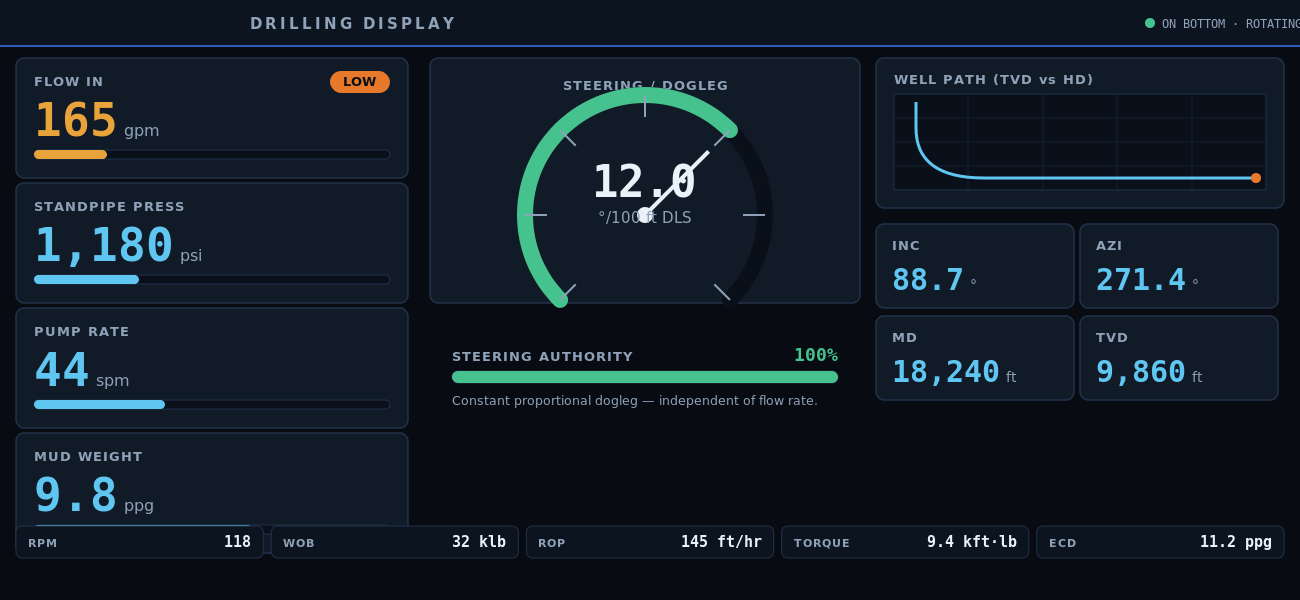
Hydraulically actuated RSS generally require a minimum flow rate and back-pressure to generate steering force.
In low-GPM applications — smaller hole sizes, managed-pressure drilling, depleted reservoirs, or flow-limited rigs — those tools lose steering authority or cannot reliably actuate at all, forcing operators to pump harder than the well wants or abandon RSS for a steerable motor.
Kontour’s bit side force is not dependent on mud flow rate or back-pressure. The electromechanical steering mechanism delivers the same proportional dogleg response whether you are pumping at high rate or running lean, with no minimum-flow threshold to maintain.
That lets you optimize flow for hole cleaning, ECD, and motor performance independently of steering.
Key Outcomes:
- No minimum-flow requirement to maintain steering authority
- Consistent proportional dogleg across the full GPM range
- Optimize flow for hole cleaning and ECD, not for the steering tool
- RSS-grade well placement in low-flow and managed-pressure applications

When a well takes losses, the answer is lost-circulation material — but the small hydraulic ports and nozzles that many conventional RSS depend on are exactly what LCM plugs.
Operators are forced to limit LCM concentration and type to protect the steering tool, trading losses management against the risk of plugging or failing the RSS.
Kontour has no LCM restrictions. With no flow-path ports or nozzles in the steering mechanism to clog, you can pump the lost-circulation material the well requires — coarse, high-concentration, whatever the loss zone demands — without compromising the tool.
Steering performance is unaffected by what is in the mud.
Key Outcomes:
- No LCM type or concentration limits
- No flow-path ports to plug in the steering mechanism
- Manage losses aggressively without pulling the RSS
- One less constraint between your mud program and your trajectory
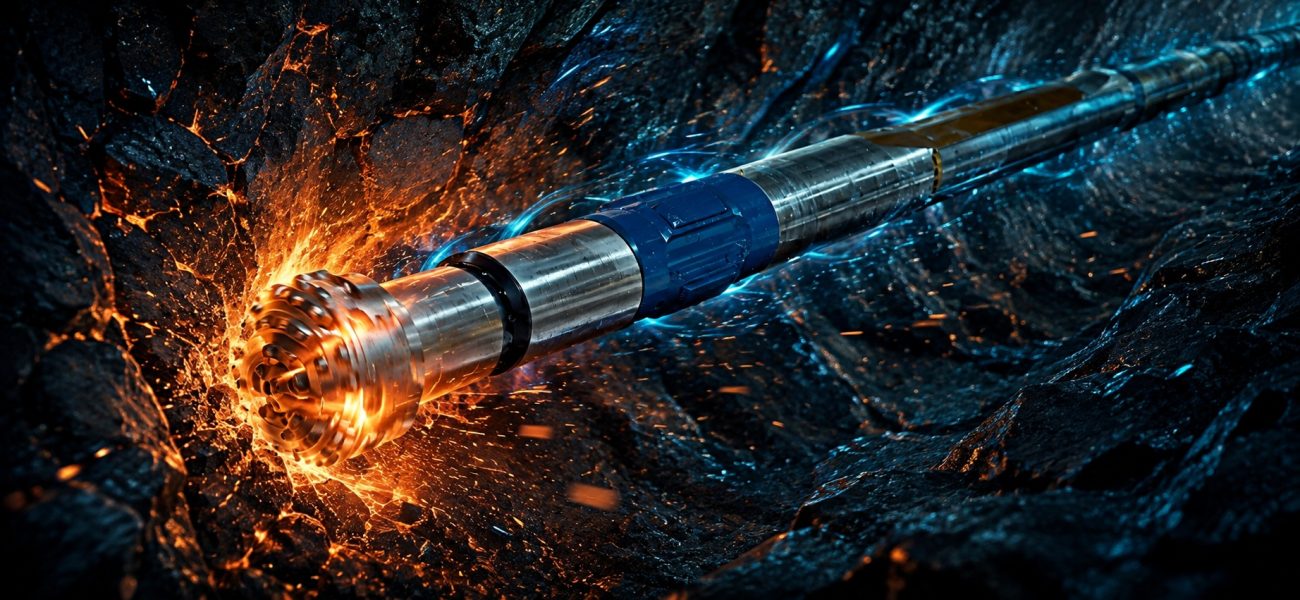
Many RSS platforms cap surface RPM and weight-on-bit to protect fast-cycling seals and high-duty-cycle steering mechanisms.
But RPM and WOB are primary ROP levers — de-rating them to protect the tool directly costs drilling rate and cost-per-foot, and can induce the very stick-slip and torsional vibration the limits were meant to avoid.
The Kontour’s housing rotates at roughly one revolution per hour, mechanically decoupled from drill-string RPM, so surface rotary speed never loads the steering mechanism.
There are no RPM, GPM, WOB, or LCM limits, and the tool is not susceptible to stick-slip or HFTO.
Drill at the parameters your bit, motor, and formation call for — the steering system keeps up.
Key Outcomes:
- No RPM or WOB ceiling imposed by the steering tool
- Steering mechanism decoupled from drill-string rotation
- Not susceptible to stick-slip or HFTO
- Drill at optimal parameters for ROP and cost-per-foot
Let’s Start a Conversation
Whether you’re evaluating a pilot well, planning your first Kontour program, or scoping a multi-rig deployment — we’d welcome the conversation. Kinetic’s team works with drilling engineers, operations managers, and technology leaders to scope engagements that fit your program and your timeline.